
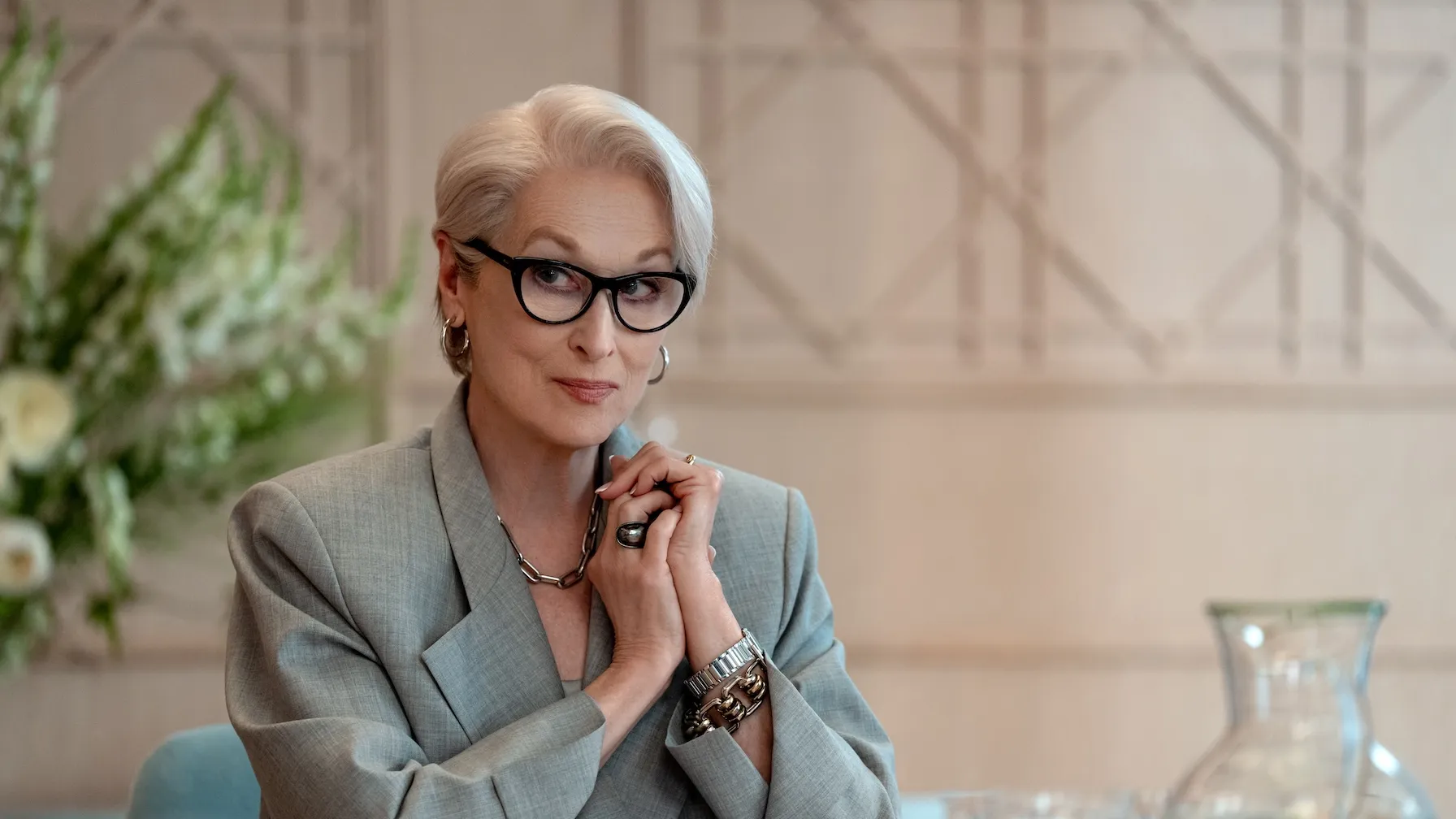
Let’s get this out of the way right away: The Devil Wears Prada 2 isn’t the feel-good movie we might have expected. We left off in 2006 with Miranda’s famous line: “Don’t be ridiculous, Andrea—everyone wants to be us.” In the pre-crisis euphoria of the early 2000s, the film showcased the cruel yet terribly fascinating face of a glossy magazine. Twenty years later, that dream is over: The Devil Wears Prada 2 isn’t a film about the fashion industry, but about the crisis in publishing and journalism.
What Has Changed (and What Hasn’t) in The Devil Wears Prada 2
The opening credits of the 20th Century Studios film (distributed by The Walt Disney Company) are a stroll down memory lane, filled with Easter eggs and references to the first film, but the tone of the film shifts immediately. The newspaper where Andy Sachs (Anne Hathaway)—now an adult with a career—works suddenly shuts down. Miranda Priestley (Meryl Streep) finds herself in the media spotlight because of fast fashion. Their paths cross again, and Andy returns to Runway, which, in the meantime, is no longer a magazine. As Nigel (a timeless Stanley Tucci) explains to her, it’s “in the ether, digitized, downloadable” because the print version “practically nobody buys anymore.”
The glories of the past are long gone: Miranda Priestley now has to hang up her coat herself and can no longer deliver her pithy one-liners because she has an assistant (Simone Ashley, a miniature Miranda) who scolds her before human resources steps in.
Streep promised us a Miranda who was “more villainous than ever,” but she comes across as more tired and lost than ever. And not just because she doesn’t remember either Emily or Andy. She, too, has not been spared by cancel culture, the whims of CEOs, and the demands of advertising investors who want—and can—dictate the newspaper’s editorial line. And this is where we find Emily (Emily Blunt), who has made a career in luxury retail and is more ambitious, disheveled, and ambiguous than before.
The director: “The first iPhone, the beginning of the end”
“To put things in perspective,” explained director David Frankel in the notes accompanying the film, “the first iPhone came out a year after the first movie was released, and I think that was, in a way, the beginning of the end. And as we watched the world of print journalism decline year after year, it made sense to explore this shift.”
Miranda Priestley, the woman capable of destroying a designer’s career with a mere pout, now has to deal with finance guys dressed in polyester. In Aline Brosh McKenna’s screenplay—now completely detached from Lauren Weisberger’s original book—she must compromise with the new titans of publishing, who have little common sense and even less good taste, but deep pockets in their padded vests. And mark my words: the one on death row here isn’t fashion journalism, but publishing as a whole, crushed between the logic of social media and that of marketing.
A Portrait of a World That No Longer Exists
Despite the commercial-style cinematography and breakneck editing—take your eyes off the screen for a moment, and you’ll miss something — The Devil Wears Prada 2 stays true to the comedy genre and gives fans everything they’ve been waiting for over the past twenty years: the clothes, the runways, the wardrobe’s wunderkammer, Nigel’s sarcasm, and Emily’s incendiary comments. Which, we suspect, will become the memes of the year. Unlike the first film, this time designers and brands competed to be featured: it’s the apotheosis of product placement. The increased budget allowed part of the film to be shot in Milan during Fashion Week. The cameos are too numerous to count—from Lady Gaga to Donatella Versace—and the new cast members bring the spirit of Gen Z to the Runway editorial office.
The first film became a phenomenon because it depicted a ruthless yet terribly fascinating world. It was a coming-of-age story about finding one’s own path and voice. Sure, Andy was treated terribly at work, but isn’t she the one who eventually changes her mind about the magazine? Who even feels a sort of reverence for it? An entire generation walked out of the theater dreaming of Chanel boots and quoting Miranda’s monologue on cerulean blue like it was the Bible. It’s very hard to imagine a teenager today walking out of the theater dreaming of working in publishing. That golden world, quite simply, no longer exists. Just scratch beneath the glamorous surface to discover that what’s on screen is our own world, where bookstores and newsstands are closing, historic buildings are becoming luxury condos, and people find out they’ve been fired via a notification on their cell phone.
A film about the importance of legacy
The Devil Wears Prada 2 is a story about the importance of preserving a legacy: the magazine’s cultural legacy, threatened by artificial intelligence and profit at any cost, and Miranda’s personal legacy. What will remain of the sacrifices, the compromises, the renunciations? Will we be remembered for what we built, or for what we lost? Symbolically, the film’s most important conversation—the clash between the old and new worlds—takes place beneath a masterpiece by Leonardo da Vinci. It is the final waltz, the Last Supper, the empire crumbling under the onslaught of capitalist barbarians. The happy ending is obviously guaranteed, but precarious: we already know which direction the world is heading, and so do Andy and Miranda. So let’s enjoy this pop dream one last time, before it ends.
