

Pain and loss are two things that are extremely difficult to come to terms with, partly because more often than not we tend to run away from ourselves—even though all the answers lie within us, within who we are, who we were, and who we might one day become. The film Supergirl, directed by Craig Gillespie, focuses not only on a character familiar to DC fans and enthusiasts, but above all on her imperfections—the inner demons that torment her existence—in a story that requires introspection to leave a lasting impact on the big screen.
The new direction of DC Studios has been made abundantly clear through its latest releases, and Supergirl is no exception in this regard. The story, centered on Milly Alcock, aims to be many different things: it wants to be fun and lighthearted, but also mature and unapologetic in its rawest moments, all framed by a narrative style suspended between introspection and a colorful, derivative aesthetic—between the inner and the outer—in a game of references designed to entertain by capturing something that feels both familiar and intriguing (if you’re a DC fan, check out our review of Superman).
What does “home” mean?

Supergirl crosses paths with Kara Zor-El (Milly Alcock) during her 23rd birthday celebration. We see her caught up in a whirlwind of dizziness, music, and indecipherable emotional chaos from which she seems to want to escape. Everything changes when Ruthye (Eve Ridley) appears on her path—a young woman who lost her family at the hands of an unscrupulous man named Krem (Matthias Schoenaerts), who, as if that weren’t enough, poisons Kara’s dog, Krypto.
Completely unexpectedly, both Kara and Ruthye find themselves on the same path, in pursuit of the same man. Both protagonists are driven by different motives—revenge, but also survival and justice. From there, a journey unfolds through the labyrinth of a lawless and unscrupulous galaxy, where the past, present, and potential future will become one with the choices these two women make.
Traumas and Ghosts
Supergirl makes its intent clear right from the very first “introductory” scenes featuring its protagonist. We see her alone, devoted to having fun and committed to a life of chaos. Obviously, the smoke and mirrors of a life without rules serve to conceal something deeper—something that Kara Zor-El herself doesn’t want anyone to see—and the film’s entire exploration is based on this relationship with pain and her eventual overcoming of it.
Kara is tormented by the loss not only of her loved ones, but of her entire planet, her home, and thus of herself—an identity that distinguishes and defines her in the vast, chaotic, and undefined universe. Her gaze, hidden behind the lenses of her sunglasses, does not want to be seen by anyone, or captured on camera, much less understood, yet it finds itself unexpectedly aligned with that of the young Ruthye.
While anger and revenge drive part of the plot in Supergirl, it is in the understanding of one’s own darkest emotions that the screenplay—which straddles the line between lighthearted comedy and an exploration of the self—finds its strength and appeal. Through this blend, the visual storytelling succeeds in both engaging the audience and leaving a lasting impression, unfolding into a narrative that is both expansive and multifaceted. The journey is another constant, serving as the glue that binds together many different situations—some more successful than others—that constantly drive the rhythm of a narrative that is at once simple and familiar yet complex.
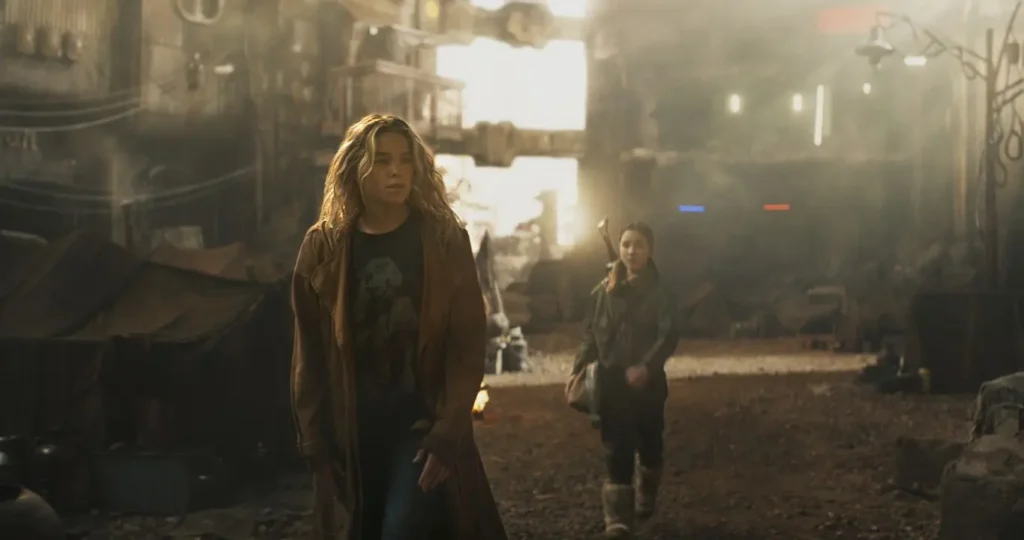
There is a lightheartedness to Supergirl, but also an interesting exploration of the film’s style—one suspended between classic science fiction, steampunk, and certain set design and costume choices that might evoke the style of Mad Max, to give a direct and immediate example. On the other hand, however, the narrative fails to surprise much in certain fairly predictable moments and may become tedious due to some repetitions overall.
Supergirl is a film that aims to stand out and leave something interesting at the end of the story—that much is clear. Kara’s story serves as the thread tying together a journey—both physical and emotional—that’s entertaining and full of interesting elements, supported by Milly Alcock’s practically flawless performance in a role that still has a lot to offer fans, as well as by Jason Momoa’s work, which brings to the big screen a Lobo who, in some ways, is already iconic in his own right.
Special mention must also be made of the film’s soundtrack, as well as Gillespie’s direction—he never holds back, striking a balance between the epic quality of functional, unobtrusive slow motion and his desire to capture key moments in Kara’s maturation through powerful, memorable shots.
This marks Supergirl’s cinematic debut, yet there’s certainly curiosity about future stories, especially if the love for the character remains as strong as it is in this film—which certainly doesn’t take too many risks, doesn’t stray from an easily predictable overall narrative, yet still leaves a lasting impression, all things considered.
Supergirl is a comic-book movie that chooses to weave together spectacle and introspection, building a story around Kara Zor-El about loss, anger, identity, and the need to belong—a story that finds its strongest emotional core in its protagonist. Craig Gillespie crafts a journey through trauma and rebirth, blending science fiction, lightheartedness, and melancholy, as he seeks to give the character a dimension that is as human as it is epic, supported by an intriguing visual style and a cast perfectly attuned to the story’s tone. However, there remains the sense of a visually driven work that, while leaving a mark through its sensitivity and intentions, does not always manage to shake off an underlying predictability and a narrative caution that limit, at least in part, its overall impact.
