
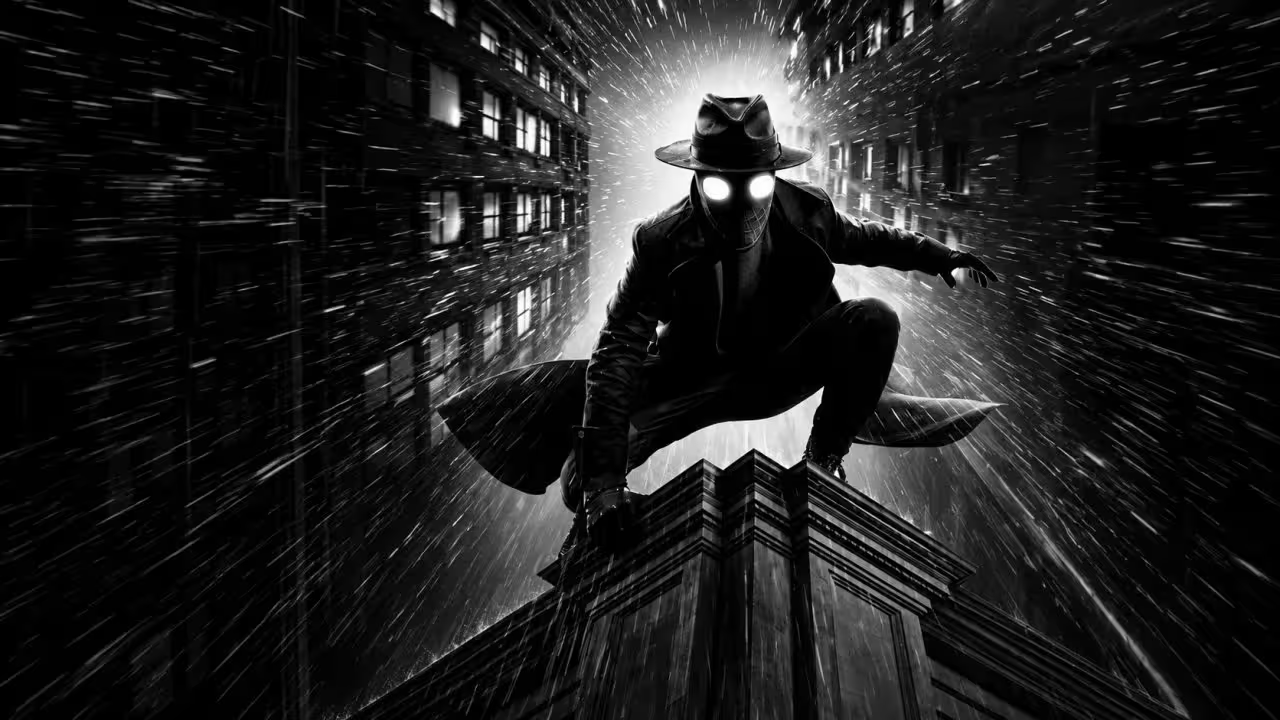
Tough guys, babes, gangsters, and spiderwebs. In an era of frantic, overly cluttered visuals, where speed seems to be the golden rule, series like Spider-Noir are something of a rarity. It offers a completely opposite perspective, focusing on a deliberate, almost ethereal narrative—but, let’s be clear, one with exquisite craftsmanship. Showrunner Oren Uziel certainly isn’t afraid to demand a little more from the audience, paying direct and indirect homage to the hard-boiled imagery of the 1930s and 1940s, spanning both film and literature.
Filmed in both color and black-and-white—the black-and-white version is recommended, but the choice is up to the viewer; both versions are available on Prime Video—Spider-Noir is a reimagining of the 2009 Marvel Comics variant, starring a fascinating noir version (as the title suggests) that later gained fame thanks to Spider-Man: Into the Spider-Verse. In that animated film, he was voiced by Nicolas Cage. The same Cage who, in a production by Phil Lord and Christopher Miller, plays him in the show developed by Uziel alongside Steve Lightfoot, drawing inspiration, in his own words, from “Humphrey Bogart and Bugs Bunny.” Genius, as always.
Spider-Noir: Welcome to Roaring New York (Among Spiders and Gangsters)
Over eight episodes, Spider-Noir tells the story of Ben Riley. The setting is 1930s New York. The city is beginning to rise up around Midtown, traffic is increasing, but at the same time, whiskey barrels are running low. At least the legal ones, given the grip of Prohibition. Ben, disheveled and bruised, thinks back to the days when he was The Spider. He was good at keeping outlaws at bay. Now, carrying the shadow of a major trauma, he has abandoned his idealistic mask to give in to cynicism and alcohol. He runs a private detective agency, kept afloat almost exclusively by his assistant, Janet (Karen Rodriguez).
Things take an unexpected turn when Ben is hired by nightclub singer Cat Hardy (Li Jun Li), a classic embodiment of the femme fatale. The detective must track down the woman’s bodyguard, who, it seems, is consumed by his strange superpowers. The investigation leads him to the Irish mob boss Silvermane (Brendan Gleeson), who, thanks to Prohibition and the criminal turmoil, is enjoying a veritable golden age. The detective, therefore, discovers that in New York, he is not the only one with “great power and great responsibility.” To get to the bottom of the mystery and prevent Silvermane from getting the upper hand, he has no choice but to return to being The Spider. Helping him is his journalist friend Robbie Robertson (Lamorne Morris).
An existential take on Spider-Man. But the script isn’t exactly brilliant
If Spider-Man (and Spider-Noir) cannot exist without New York City, it’s thrilling to see the effort put into recreating the urban setting, capturing the timeless charm of a place that—from comics to film—has made the character great, including his alternative versions. In this sense, the technical aspects (and one cannot fail to mention Darran Tiernan’s cinematography) play a fundamental role in the series’ narrative, which, as is traditional (and without inventing anything new—is that a flaw?), reflects on the sins to be atoned for, the torments, and the sense of oppression experienced by a human and vulnerable hero. Shortness of breath, slurred speech, a vampire-like gaze—enough to bring to mind a certain Bela Lugosi.
Inside, amid a whirlwind of tones and moods—where action is present but sparingly—the show plays on the verticality of the setting (from the Art Nouveau spires of the Chrysler Building to the wet asphalt reflecting the lights of Broadway) and, in parallel, on the very concept of noir and pulp, painting an expressionist and unconventional fresco. At times, it feels like reading Raymond Chandler or, why not, watching Orson Welles’s The Lady from Shanghai. At other times, Spider-Noir almost feels like an Edgar G. Ulmer B-movie.
Comparisons of this caliber raise the bar and, indeed, make the show worth watching. To be clear: as noted at the beginning of our review, the writers didn’t take the easy route, aiming instead for a comprehensive narrative that is, if you will, deliberately (too) restrained (and even a bit tedious at times), relying on flashes of irony and, once again, an extremely recognizable visual style.
In short, the script isn’t exactly brilliant; it touches on various themes without, however, really digging in or making the overall setting—which is objectively appealing—truly gritty. Nevertheless, there is an emotional payoff, tied to a character with a strong impact. In a way, Spider-Noir is almost a standalone entity within the Marvel universe—so much so that the story stands on its own, which is a good thing—and it thrives primarily thanks to its undeniably dazzling visual style. Oh, and we almost forgot: Nicolas Cage is perfect in the trench coat of Ben Riley/Spider-Noir. But that’s hardly news.
Conclusions
Nicolas Cage becomes The Spider in a series that revisits the noir and pulp genres of the 1930s and 1940s, recreating a roaring New York City. Elegant and surprising in its staging, Spider-Noir offers an alternative to Marvel productions (avoiding clichés) but, at the same time, suffers from a script that isn’t particularly brilliant and, on several occasions, borders on the stilted. However, on the other hand, there is a clear pursuit of originality, making the series a highly impactful piece of work.
