
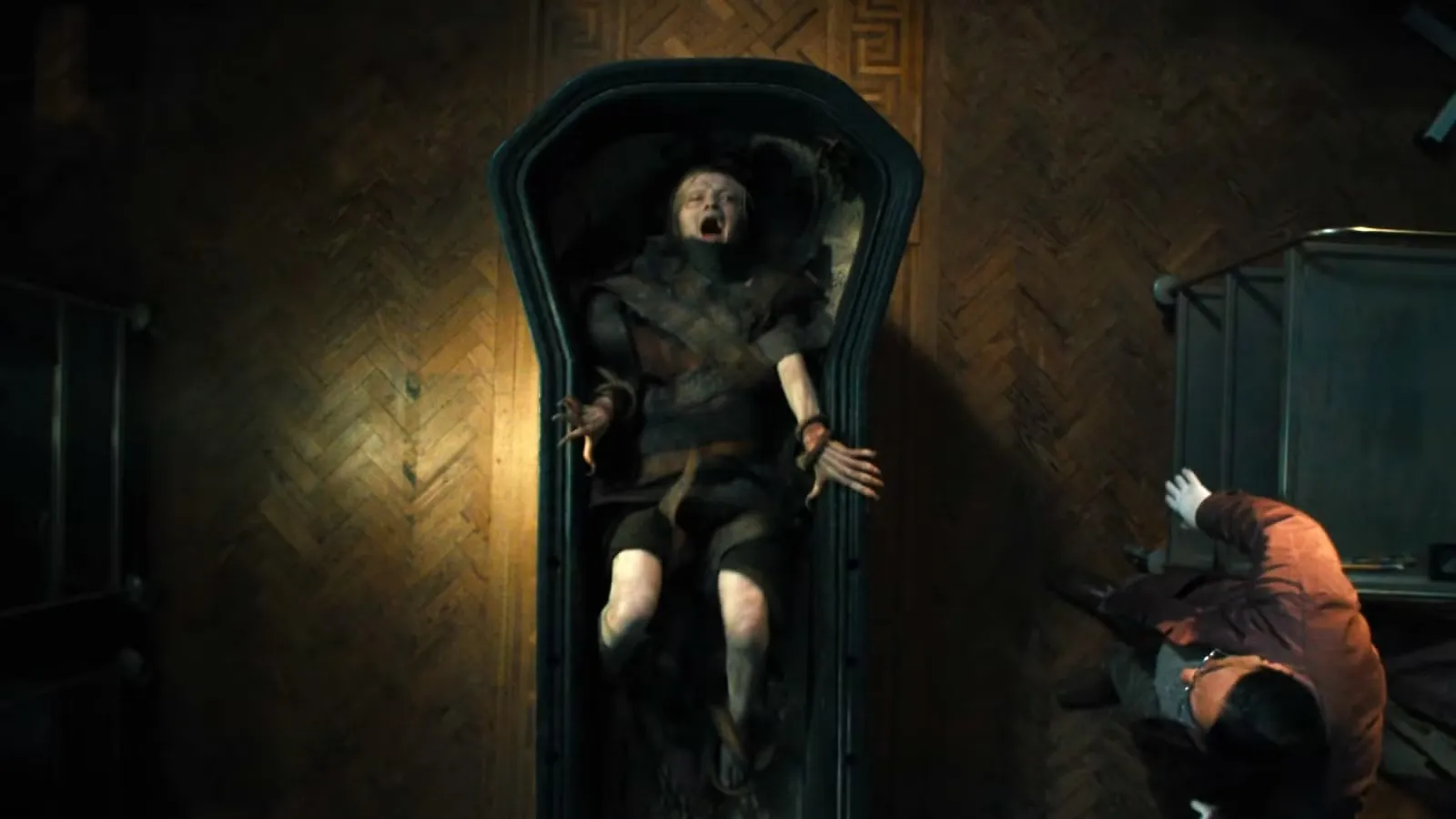
Not all horror films are truly horror. Especially in recent years. Many are atmospheric films, others are more interested in heavy-handed political metaphors, and others, like The Invisible Man, are exceptional films of tension rather than horror. Lee Cronin’s The Mummy, however, is a true horror film. It certainly doesn’t have great writing, the acting is pretty bad, it’s staged with an emphasis that often makes no sense given what’s happening, and it’s very derivative. But when it comes to doing the job of a horror film, it doesn’t hold back. Among the many criticisms that can be leveled at the film, timidity is certainly not one of them.
Like the other classic monsters that Blumhouse has reimagined (the aforementioned 2020 The Invisible Man and 2025’s The Wolf Man), the story of The Mummy 2026 bears little resemblance to that of the original 1932 film; it has been transformed into a family-friendly tale and, in doing so, reimagined. While the new The Invisible Man subverted the basic premise by casting a woman as the protagonist—stalked by a man who invented a suit to become invisible, and thus obsessed with the fact that he is always there—and the film about the werewolf approached the story from the monster’s perspective, depicting the slow loss of humanity and connection with his family, this one takes the ancient mummy and discards it in the opening scenes. The idea is to replace it with a kidnapped girl found eight years later. The enthusiastic family welcomes her back into the home, but she is no longer the same—she has been mummified and (they don’t know it yet) cursed. So they have the mummy in their home, right next to the other children and the grandmother.
As always with Blumhouse films, the premise is solid, and since James Wan (the man behind Saw, Insidious, and The Conjuring) is also producing, he isn’t afraid to showcase repulsive imagery. The gross, the repulsive, and the painful serve as a constant drumbeat throughout the film, and if you have a taste for that sort of thing, it helps you get past even the most ridiculous parts. For example, there are the scenes where the mummified little girl returns home, and it feels like watching that Simpsons episode with Bart’s evil twin in the attic. Or the scenes with the Egyptian policewoman who investigates and acts like American cops, dresses like American cops, eats in front of her computer like American cops, and shoots anyone like American cops.
Fortunately, the further Lee Cronin: The Mummy progresses, the more Lee Cronin emerges—that is, the screenwriter and director who earned his name in the title not for fame or status (his previous films weren’t exactly hits), but simply because Warner desperately needed to make it clear to everyone that this isn’t a reboot or sequel to the Mummy series starring Brendan Fraser. Cronin isn’t a great screenwriter, but at least he’s full of horror ideas, and he knows how to have fun.
This makes everything more believable, and the chaos that erupts during the grandmother’s funeral—with multiple characters and all sorts of horrifying events unfolding simultaneously—triggers that classic Blumhouse-style sense of an entire house being possessed. Even a brief reference to the Shining soundtrack at a moment when what’s happening seems like Shining in reverse doesn’t feel ridiculous or contrived; rather, it reveals that, in the end, of all the family members involved in the story, the father is the true protagonist. He is the one who wasn’t there when the little girl was abducted; he is the one investigating to figure out what happened; and he is the one who, despite an annoying resemblance to Seth Rogen, takes charge of the situation.
It won’t be hard at some point to recognize how Lee Cronin decided to help his film by borrowing a few solutions from The Exorcist. But perhaps that is precisely what makes it interesting. Beyond the reference, the way this film chooses at a certain point to resemble that one—without the Church and without the priests—gives it a much more serious tone. There is no mediation nor hope for purification from a higher power; there are only parents who must literally take the guilt upon themselves.
