
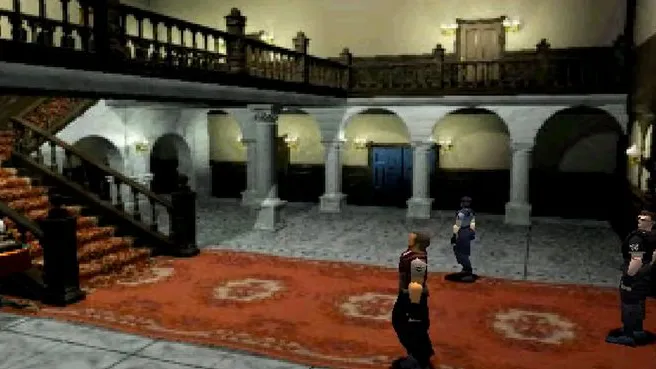
Perhaps the first thing that comes to mind when thinking of Resident Evil is a creaking door, the woods of Raccoon City, or the entrance to Spencer Mansion. That feeling that there’s always something—or someone—following you through the labyrinthine rooms of the mansion, lurking around every corner. Thirty years have passed since March 22, 1996, the day the game was released in Japan on PlayStation, and that feeling has never ceased to linger in the memories of gamers and fans, nor has it stopped settling and regenerating over time, through new chapters, remakes, adaptations, and novels.
The game’s development took three years; initially, Mikami created the first sketches on his own (by the final stage of Resident Evil’s development, the team consisted of over 80 people), writing the characters and the script, and drawing inspiration from famous horror stories, such as Kubrick’s 1980 film, The Shining, which is impossible not to think of when looking at the mansion, and George Romero’s 1978 film, Dawn of the Dead, from which the game draws its settings, atmosphere, claustrophobic corridors, and that sense of siege weighing on the protagonists, and of course Alone in the Dark, Frédéric Raynal’s Lovecraftian detective game, whose similarities are quite evident, starting with the theme of both games—surviving in a mansion overrun by monsters—as well as the fixed camera angles and restricted field of view. It is no coincidence that Mikami himself, in an interview with Le Monde, stated that “Without him, Resident Evil would likely have become a first-person shooter.”
The Visual Language of Fear
Mikami thus succeeded in crafting a visual narrative with its own language of fear, in part through strategic visual elements. Among these is the use of a fixed camera, which determines the visual angle from moment to moment, room to room, serving as a tool to amplify fear and intensify anxiety, designed with blind spots to heighten the tension. Added to this is the creation of detailed backgrounds and environments, realistic atmospheres that generate an unprecedented sense of unease. It is precisely from the synergy and blending of these techniques—supported by horror direction designed to make the character feel constantly watched or in danger—that the effect of moving within a sort of interactive photograph emerges, a crucial element in defining the visual identity of survival horror.
The game was released in 1996 under the title Biohazard in Japan and Resident Evil in the West. It was so successful that a revised version, Resident Evil: Director’s Cut, was released shortly thereafter, and Mikami established himself as one of the most influential Japanese developers in the industry.
The events take place in July 1998 in Raccoon City, a fictional American town. The S.T.A.R.S. special units Alpha and Bravo are sent to the scene to investigate a series of cannibalism and murder incidents that have struck the area. It is here that players embark on an adventure that begins at night, in a forest. When the Bravo team vanishes, a team consisting of Chris Redfield, Jill Valentine, Albert Wesker, Barry Burton, Joseph Frost, and Brad Vickers is deployed to find out what happened. When the Alpha team lands near an abandoned mansion, a pack of particularly aggressive Dobermans attacks the group, and the survivors take refuge in the only nearby building. That seemingly uninhabited mansion is actually the entrance to a secret Umbrella Corporation laboratory, where experiments and research for military purposes are conducted—research that has given rise to mutant creatures, as well as a virus capable of altering living organisms. The pathogen has spread uncontrollably, transforming the facility’s entire staff into violent, mindless undead.
The Film Adaptation
The game’s success was immediate and extraordinary. Resident Evil sold over five million copies and was also the first game to be labeled a survival horror title. Since then, the franchise has never looked back, spawning prequels, remakes, and sequels such as Resident Evil 2, Resident Evil 3: Nemesis, Resident Evil Code: Veronica, and Resident Evil 4. The franchise has expanded far beyond video games, making its way to the big screen with a series of horror and action films directed by Paul W. S. Anderson and other directors, a series loosely based on the video games starring Alice—a character created for the films and portrayed by Milla Jovovich.
The first film based on the video game series was met with widespread skepticism, given that the project had originally been entrusted to George Romero; however, after the director turned it down, the production team turned to Anderson, who had previously worked on the film adaptation of Mortal Kombat and directed the sci-fi horror film Resident Evil. The 2002 film, produced, written, and directed by Paul W. S. Anderson and starring Milla Jovovich, takes place inside an underground base belonging to the Umbrella Corporation. The facility’s central computer, known as the Red Queen, completely seals off the base following the spread of the T-virus: no one can enter, no one can leave, and everyone inside is eliminated. A search team is sent from the outside to investigate what happened, while the protagonist, Alice, wakes up inside the base with no memory. Together with the other characters, she must discover what turned humans into zombies and animals into monstrous creatures.
The film does not retain the game’s characters but faithfully preserves the monsters and the atmosphere. The director crafts a solid story with a straightforward, self-contained plot that is enjoyable even for those who have never played the video game. Within the overall scope of the film series, this first installment remains arguably the best—a well-crafted zombie movie that balances action and suspense with a certain narrative elegance.
The film franchise continued with seven more films: two reboots—one of which is set for release in 2026 and directed by Zach Cregger—and five sequels, all written by Paul W. S. Anderson, who directed three of them; the other two were directed by Alexander Witt (Resident Evil: Apocalypse) and Russell Mulcahy (Resident Evil: Extinction), respectively. The series proved to be a remarkable commercial success, grossing a total of over one billion dollars at the global box office, becoming the highest-grossing film series based on a video game of all time, and establishing itself as a full-fledged cultural phenomenon.
Thirty years later, it’s impossible to look at the landscape of video game horror without seeing the silhouette of Spencer Mansion. Its influence has shaped the entire horror genre that followed, from Tormented Souls to Daymare: 1998, and even Silent Hill, Parasite Eve, and Dead Space. It defined the standards of a genre by demonstrating that a video game could generate genuine terror through architecture and the creation of hostile spaces. Resident Evil still terrifies today, not so much because of its monsters but because of its locations. The fear and tension don’t stem from what’s chasing you, but from the environment in which you’re forced to move. This, perhaps, is its most authentic hallmark as a survival horror game.
