
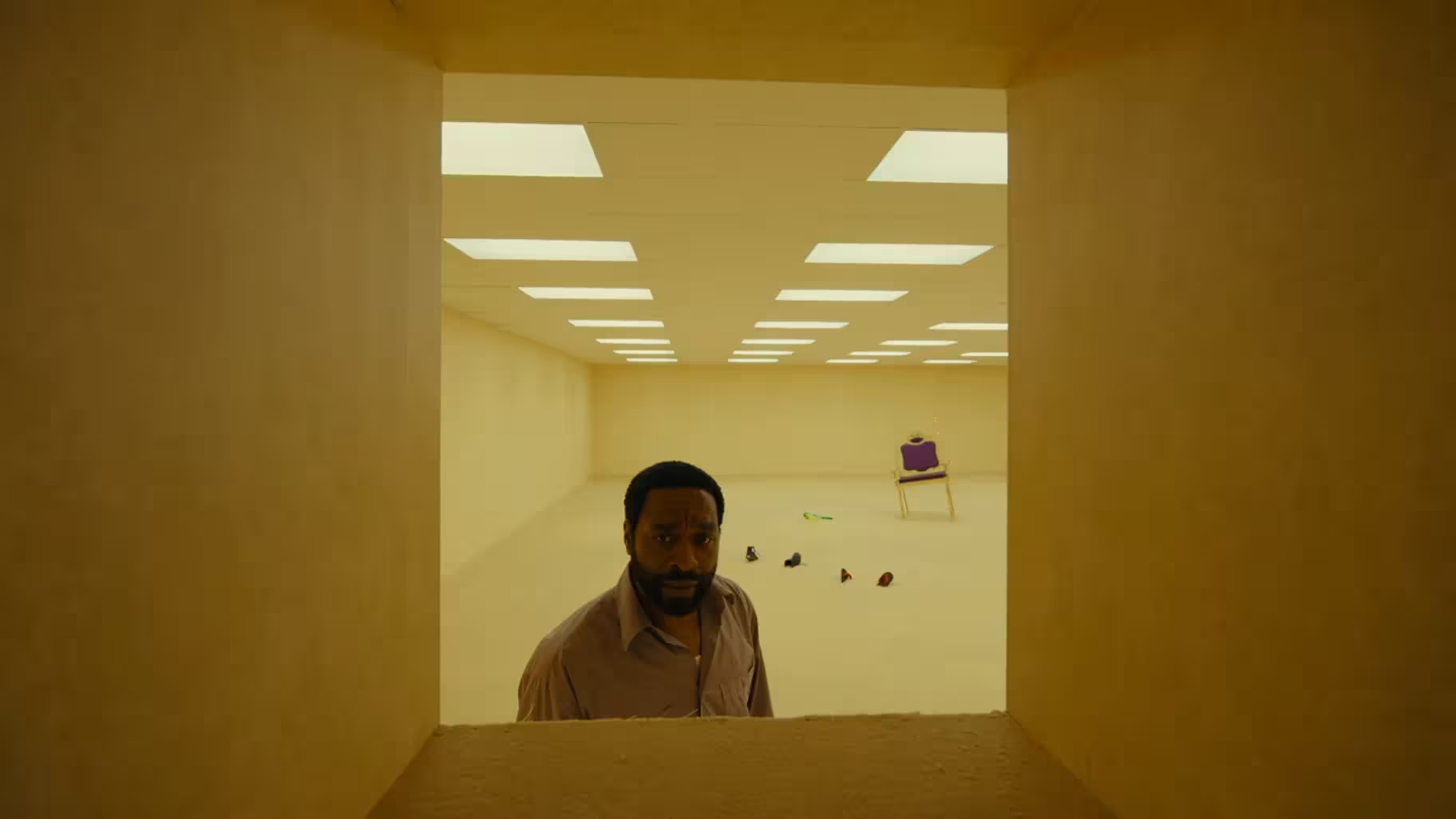
The Philippou twins, Curry Barker, and now Kane Parsons: mainstream cinema is increasingly turning to the creative pool of YouTubers in search of horror talent. It’s by no means a bad move, because this latest emerging artist, who has just hit theaters with Backrooms, is proving to be a major revelation. Just as the creators of Bring Her Back are obsessed with the concepts of grief and pain and the creator of Obsession is immersed in social nihilism, Parsons is drawn to the surreal: he could be Lynch’s heir; he is certainly already a child prodigy (he’s twenty).
Backrooms is a liminal horror and an elevated horror, but also a science fiction tale, of the metaphysical kind that evokes Tarkovsky and Solaris. Let’s take a step back: around 2019, the first image of a lit room with yellow walls appeared on 4chan, the first of an indefinite number of bare or sinisterly furnished rooms that would become Parsons’ Backrooms. Sixteen years old at the time of the first episode he created, Kane expands the creepypasta, transforming the labyrinth of rooms into the manifestation of a space-time distortion where scientists wander in an attempt to understand its nature.
If you follow the director’s YouTube channel, you probably already know all about the origins of the mysterious Complex, but here we’d rather keep you in the dark. In the episodes—mostly anthology-style—the protagonists are members of the Async organization who explore the complex, or the unfortunate souls who stumble upon it by accident. In the film, however, architect Clark (Chiwetel Ejiofor) vanishes into a crack discovered in the basement of his furniture store. His psychotherapist, Mary Kline (Renate Reinsve), enters the complex to search for him. Later, Phil (Mark Duplass) appears, an Async scientist whose role is to connect the film to the online lore and steer the movie toward the sci-fi genre.
In this triptych, the first part investigates the fates of the protagonists, the second explores the alienating, labyrinthine structure of the rooms, and the third focuses on the nature of the backrooms. Parsons demonstrates an admirable mastery of aesthetics: the architectural landscape of the stark, aseptically lit rooms in shades of yellow takes on a surreal and sinister aspect when one encounters rooms where furniture and objects blend into the floors or walls.
It feels like being in one of those never-ending dreams from our most tormented nights, where we wander aimlessly, feeling trapped in a non-place that seems both familiar and alien at the same time—and “wrong”—the result of how the subconscious replicates the places we frequent during the day, but in a slightly distorted way. There, around every corner, hide horrible things—the manifestations of our pain and our traumas—whose presence we sense and whom we fear. The most intriguing aspect of the film is probably the self-destructive resourcefulness of its characters: the protagonists are not pursued by horror; they themselves advance, room after room, toward it.
They do so without being driven by the promise of a reward, without the guarantee of an exit, as is the case in Exit 8. Although, unlike the latter, it is not based on a video game, Backrooms is structured as a first-person game, where we see through the eyes of the protagonists. Disorienting and infinite, the space adapts to the guest, drawing on their psyche and memories. Yet, lacking the ability to fully comprehend them, it uses them to create distorted replicas, much like when we ask artificial intelligence to give form to the images we suggest with grotesque results, or as in one of Francis Bacon’s paintings so beloved by David Lynch.
The result is a senseless, absurd, unsettling aesthetic captured in the style of found footage shot on Super 8, but with the grainy, analog look of 1990s VHS tapes. In the series, the soundtrack distances itself from typical horror sounds, accompanying the characters’ wanderings with mall-style music, as if the unfortunate victim were wandering from one area to another in a giant outlet mall where they’ve been locked in overnight. In the film, the soundscape is less bizarre, but the horror relies heavily on what is “heard”—namely, screams and sinister noises that signal the presence of terrifying creatures.
The realization that the monsters are not native to the setting but rather human aberrations transformed by madness and prolonged confinement within the labyrinth adds the most effective element of fear. The deliberately open ending leaves much unresolved, setting the stage for who knows how many sequels. While the first installment presents itself as a psychological horror metaphor for personal trauma, the subsequent installments promise to explore the sci-fi implications of the Complex, and that’s where things will get even more interesting.
