
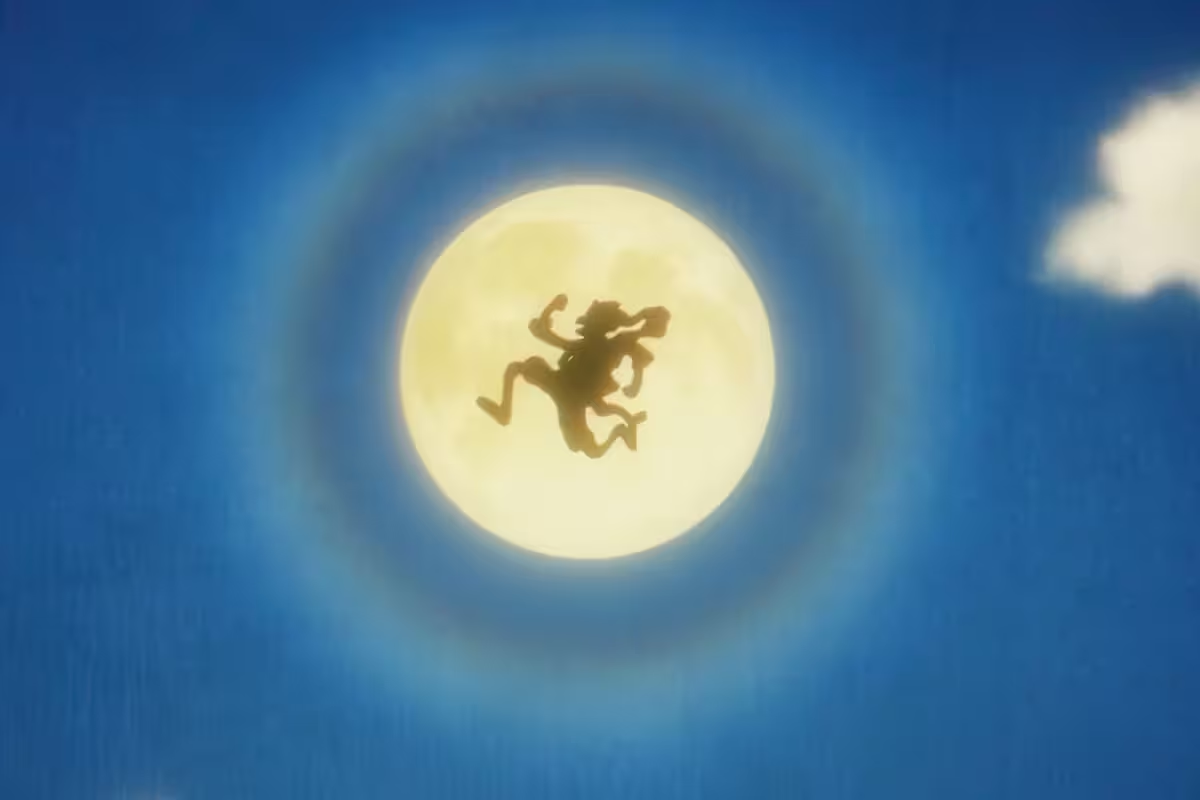
Warning: Spoilers for Chapter 1179 of the One Piece manga
One of the hottest names in One Piece‘s recent history is Joy Boy. The character who once stood up to the World Government and the last known person to possess the power of Nika seemed like a legend plucked from Eiichiro Oda’s manga, but the truth is that the mangaka drew a little (or a lot) of inspiration from an African legend of the same name.
As can be read and seen in the book Encyclopedia of Things That Never Were: Creatures, Places, and People, written by the navigator Michael Fitzgerald Page and the illustrator Robert Roger Ingpen in 1985, there was a legend about someone named Joy Boy, a person who, according to the legend, “smiles perpetually at all of humanity’s weaknesses and problems, and cures human ills by beating an irresistible rhythm on his drum.”
“Anyone who hears Joyboy’s music is compelled to dance and sing until they shake the black cloak of despair from their shoulders. Some jazz musicians claim to have captured Joyboy’s rhythms, but their attempts are a pale imitation of that frenzy of dance that can make people dance until they collapse.”
As Page recounts, this character sought to bring happiness to the people around him through the rhythm of his drums—a theme directly linked to the drums of liberation heard when Luffy transforms into Nika. This makes it clear that this God’s purpose is to liberate the oppressed and make them dance to his beat.
Although this is a legend, the description provided in the book makes direct reference to a very specific religion of West Africa, the Yoruba, which is commonly found in areas of Nigeria and Benin. Among all the gods or deities, who in this religion are called Orisha, one stands out in particular: Ayangalu, considered the religion’s first and foremost drummer.
It’s quite interesting that a name like Joy Boy comes from a religion as obscure as Ayangalu, but that’s not all. If you recall, the mural mentioned a “God of the Forest,” a concept that also exists in Yoruba folklore under the name of Ajá. He is an orisha who protects the forest and the animals within it, and is also a healer who uses the secret of herbs to heal those around him. This relates directly to none other than Chopper, whom we’ve discovered over the last few episodes is, in some way we still don’t understand, capable of reversing the Giants’ Domi Reversi with just a single punch or blow to the affected individual.
Imu the Witch
But if you think that’s all there is to it, you couldn’t be more wrong. There is another figure called Iyami Oshooronga, who, according to this religion, are a kind of witch representing the feminine figure, and are capable of controlling the life of any mortal. Furthermore, when this figure speaks, everyone around her must bow down to her to avoid incurring her wrath. Doesn’t that remind you of a certain World Government villain who just appeared in the manga? Indeed, we’re talking about Nerona Imu.
And to top it all off, Oda has revealed that Imu belongs to the Lunaria race, a dark-skinned race that lived in the Red Line and possessed overwhelming power—so much so that nearly all of them were eradicated by the World Government. Furthermore, both the Yoruba and the Lunaria have tribal tattoos on their faces to identify the family or lineage to which they belong. Oda has certainly found some fascinating sources of inspiration for his magnum opus, and I’m eager to gradually unravel everything the mangaka has in store for us in the coming episodes, where Imu’s mission in this world will be revealed bit by bit.
