
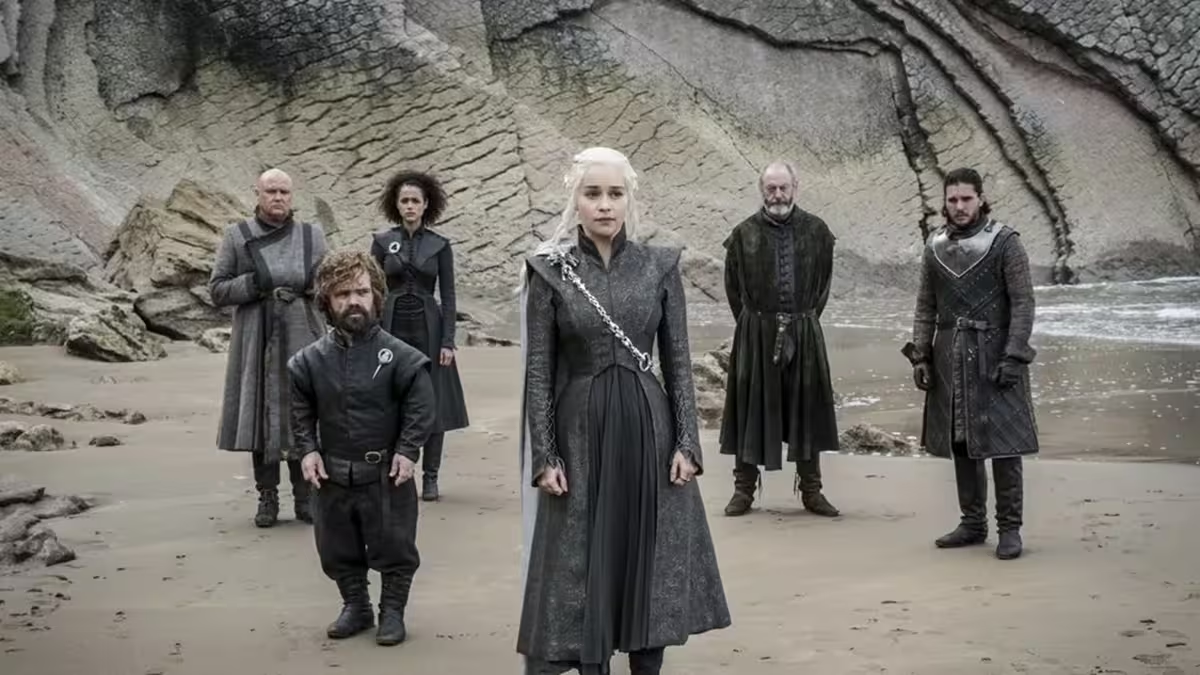
There is a before and after Game of Thrones, a layered, complex saga—medieval and fantasy only on the surface—that runs perpendicular to our reality and is prophetic of our times, leading us into a ruthless and bloody world composed of seven kingdoms and as many houses fighting for a single ambition: to conquer the Iron Throne and, with it, absolute dominion. When the TV series, born as an adaptation of the literary saga A Song of Ice and Fire, debuted on HBO exactly fifteen years ago, it was difficult to predict precisely how much its imagery would impact pop culture, how much its dialogue—woven like silk around unforgettable characters—would remain etched in the collective memory, or how much its plot twists would redefine the very concept of television storytelling.
George R.R. Martin has crafted a world populated by nobles, knights, and ladies, where no one is immune, no human is safe—a world inhabited by few, unshakable certainties: namely, that power is seductive and corrosive, that it changes its mask but not its face, and that “good” and “evil” are semantic categories that power does not inhabit. Power in Game of Thrones has no morals, no conscience; it shifts from one hand to another, and often slips out of control. Martin has shown us conflicts that flare up over nothing, driven by conspiracies, manipulations, empires that implode due to ancient grudges, fratricides, regicides, bastards who become kings, little girls who transform into shrewd and silent predators, queens who set entire cities ablaze.
A phenomenon that has changed television
A saga that has become a cultural phenomenon, a television event that is measured not only by its ratings or the Emmy Awards accumulated over eight seasons, but by the authentic depth of its characters, the moral complexity of its antagonists—traitors, martyrs, monsters, hypocrites, vengeful souls, gloomy figures, and the virtuous (very few)—characters who embody conflicting emotions within a single being. A world that explains, from the very first scenes, like a political treatise, that reality rarely rewards the righteous, that alliances are forged and broken for convenience, and that the truth pays the most immediate price.
The story revolves around several noble families vying for control of the land of Westeros, home to the Iron Throne of the Seven Kingdoms: the Starks, Lannisters, Baratheons, Targaryens, Tyrells, Martells, Arryns, Greyjoys, and Tullys. The struggle for the throne leads these noble families to forge alliances and clash with one another in increasingly brutal and violent conflicts. Meanwhile, a dark threat looms on the horizon: a winter unlike any other, awakening forgotten creatures and unleashing ancient forces for which no one is prepared.
Game of Thrones has revolutionized fantasy, reaching unprecedented levels of popularity; it has introduced a language—or rather, several languages—such as Dothraki and High Valyrian, as well as quotes and phrases that have entered the collective imagination, such as “Winter is coming,” “A Lannister always pays his debts,” “What is dead may never die,” or “What do we say to the God of Death? Not today.” Phrases that have become increasingly popular, leaving an ever-deeper mark on contemporary culture.
The Ambiguous Face of Female Power
But beyond the series’ memorable lines and striking quotes, it is the characters—especially the female ones—who have forged a powerful connection with the audience. These are characters who live in a hostile, radically male-dominated world, who endure the most atrocious abuse, who are sold to the highest bidder, tortured, raped, humiliated, and exiled—simply for being alive, for the crime of existing, or for having looked at or spoken to the wrong person. The world they inhabit is relentless and ferocious, and they, in turn, become so as well.
Cersei Lannister is relentless, a queen who was granted every privilege in life only to discover she is trapped within a golden cage as elegant as it is confining. Eternally driven by her thirst for power, she abandons everything—all boundaries, all limits—to obtain it or maintain it, effectively bringing an end to her own lineage. A life spent between feigned loves and forbidden loves, in which she was forced to desire what she could never love and to love what she should never have desired. Hers is one of the most compelling narrative arcs, a violent story that imposes itself with ferocity, feeding on the fear of others, and which is also expressed through what she wears, through her aesthetic, which changes from season to season, transforming her hair—which is cut off as a form of extreme humiliation for her sins—and her clothes, which evolve from light and colorful in the early seasons to rigid, dark armor in the later ones.
The women created by George R.R. Martin are capable of anything, from acts of immense greatness to the most immoral horrors. Daenerys Targaryen is the Mother of Dragons, the liberator, the woman who sought to break the chains of all slavery—raised in exile, sold as a bargaining chip—who, through her quest to bring peace and freedom to the oppressed, becomes capable of any atrocity. Arya Stark is the most radical. Arya does not want to be a lady, and she is little more than a child when she decides to stop being herself. She transforms into an instrument of vengeance, reciting every night the list of names against whom she seeks revenge, and every death she carries out costs her a piece of her identity.
Flawed heroes, memorable antagonists
Throughout the long and winding storylines of this series, there are moments when we feel sympathy and a sense of connection for various characters—lighthearted, hapless, even a bit unlucky and inadequate—from Jaime Lannister, Cersei’s brother and lover, who is maimed and imprisoned, and through those experiences discovers another side of himself, another way of being in the world, another way of being heroic, to Tyrion Lannister, who compensates for physical discrimination with sharp wit, biting sarcasm, as well as profound intelligence and a stubborn fondness for women and alcohol. The most interesting description of the character comes from Peter Dinklage himself in an interview with Variety: “Dwarves often appear in the fantasy genre, but when they do, they’re always caricatures, creatures of the woods, or the punchline of a joke. No one gives them a love story. No one gives them fully developed personalities, and Tyrion is one of the richest characters I’ve ever encountered. He’s a human being.”
And Jon Snow, King in the North, the only bastard son of Eddard Stark, a man caught between two crushing forces: a truth and a destiny he did not choose. An honest man, a hero, and a reluctant leader who sees dialogue and common ground where others see only rifts and divisions—one of the few characters not driven by a hunger for power, yet destined for a treacherous and arduous path. From the very beginning, Game of Thrones has taught us not to grow attached to anyone, as the very protagonists most beloved by the audience often turn out, ruthlessly, to be the most vulnerable. From the death of Ned Stark to the brutal moment of the Red Wedding—an event that defines the series for its violence—the series shatters a narrative taboo that until then seemed inviolable: heroes do not die. “When you play the game of thrones, you win or you die. There is no middle ground.” Game of Thrones had the courage to dismantle this convention and deliver increasingly unexpected twists to the audience.
Fifteen years later, what remains of Game of Thrones is a series that changed the history of television, with its highs and lows: the final seasons, whose writing was entrusted entirely to showrunners David Benioff and D.B. Weiss, sparked debate among audiences and critics alike due to inconsistencies, unresolved subplots, and an ending that still divides anyone who discusses it today. Despite its many imperfections, it remains a powerful, effective, and deeper story than many formally flawless narratives: it is true in its portrayal of power, violence, and politics. It is true because it taught us that the most poignant and heart-wrenching stories are often the ones we need most—not to shield us from the world, but to give us the best tools to navigate it. Winter came fifteen years ago and changed us, leaving us different from who we were. Valar Morghulis.
