Image Credit: Hulu/Disney+
Nothing forges indomitable rebels quite like youthful anger. A dystopian coming-of-age story, The Testaments is the sequel series to The Handmaid’s Tale. Set about fifteen years after June’s uprising, it shows how the seeds of rebellion are sown and grow during the age when we are most passionate, fierce, and resolute. Based on Margaret Atwood’s 2019 novel of the same name, the show, which premiered April 8 on Disney+/Hulu, centers on the two daughters of June, the most fierce Handmaid who dealt the harshest blows to Gilead’s tyranny.
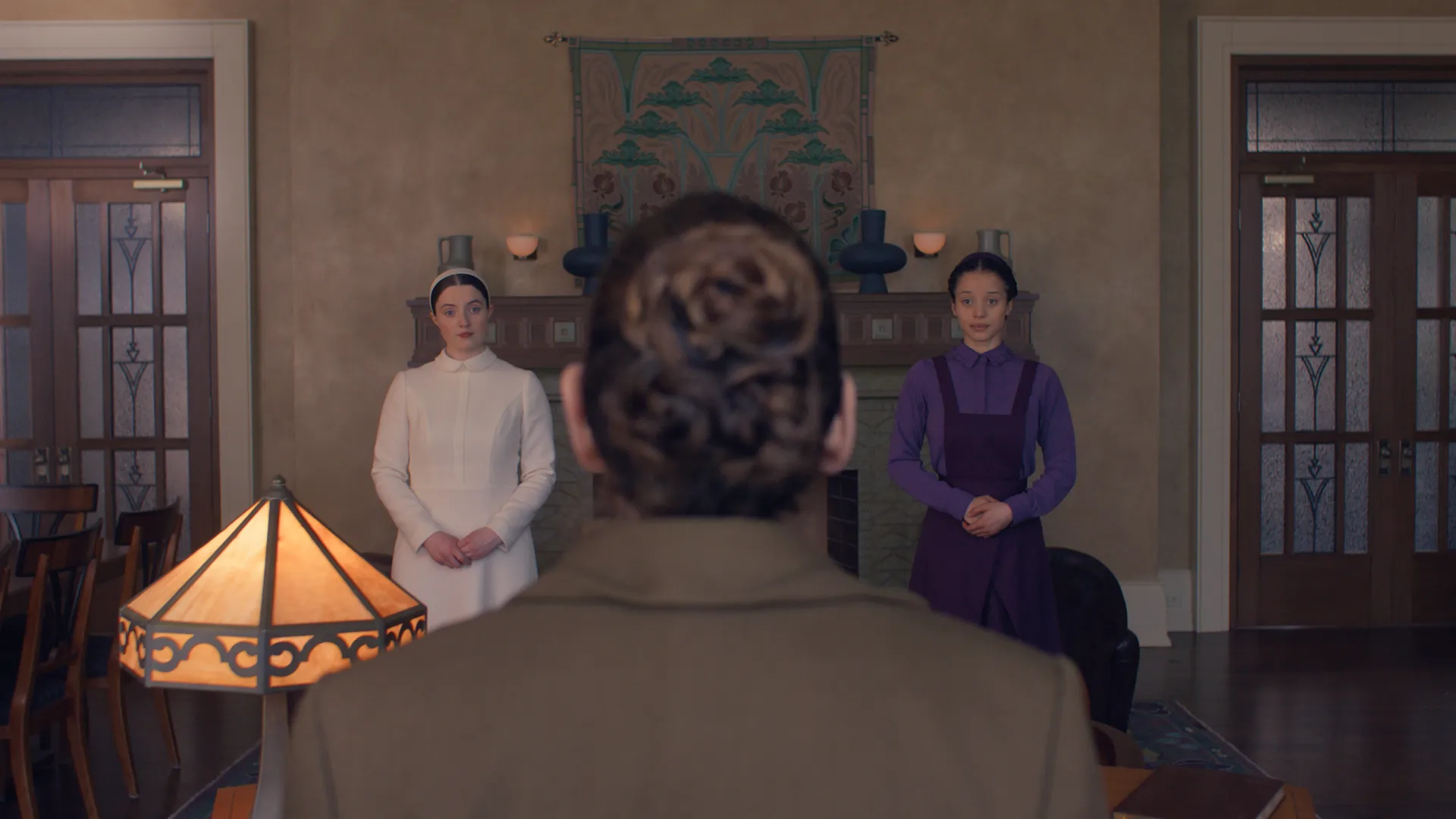
The two meet at the institute that trains the future wives of the Commanders, under the guidance of Aunt Lydia. The Testaments is likely difficult to follow without prior knowledge of the world created by Atwood, but here is a brief introduction: a severe fertility crisis leads to the establishment, within the United States, of a patriarchal regime where women are divided into fertile and infertile. Only a very few retain knowledge and power—such as the “Aunts” who train girls and women capable of bearing children—while all others are victims of a regime based on religious fanaticism, reduced to brood mares and slaves.
In The Handmaid’s Tale, the handmaid June—forced to be raped by a Commander (a leader of Gilead) and then by another to produce heirs—chose, after harboring feelings of hatred and vengeance and fleeing to Canada, to continue fighting to dismantle the system, in the hope of being reunited with her first daughter, who remained in Gilead. In The Testaments, Agnes is privileged because she is the daughter of a Commander; she is fertile and is therefore destined to become the wife of a high-ranking officer. Over time, she befriends a so-called Pearl (one of the girls recruited through proselytizing) who hides a double identity: she is both a revolutionary and June’s second daughter.
The “testaments” of the title are drawn from the stories of the two young protagonists and Aunt Lydia, a central figure in The Handmaid’s Tale who has since been profoundly changed by her experiences under the regime. A teen drama that treats its heroines as young adults, The Testaments is weak in the episodes where it gets lost in the typical dynamics of adolescence—amid jealousy and friction—but excels in its portrayal of the process (a true brainwashing) that transforms women—of any age and social background—into figures devoted to men and enemies of one another.
As in other teen dramas, there’s no shortage of pop songs (“I Am a Female Rebel” is the series’ opening track), clichéd dialogue, and superficially handled emotions. Creator Bruce Miller repeats the same mistake he made in the dystopian YA series The 100: failing to strike a balance between critiquing the system and exploring the young characters. The series works when it introduces and explores the theme of how the immense power of adolescent anger—often (self-)destructive—can be transformed into a powerful weapon of social rebellion. Chase Infiniti, the actress who rose to fame in Battle After Battle and plays Agnes, explained the strength of her heroines very well at a press conference: “The beauty of the younger generations lies in their ability to resist, and even more so in the girls’ willingness to protect one another.” The show’s message of hope resides in the resilience of Agnes, Daisy, and Becka, conveyed through a painful coming-of-age story that primarily follows Agnes’s journey.
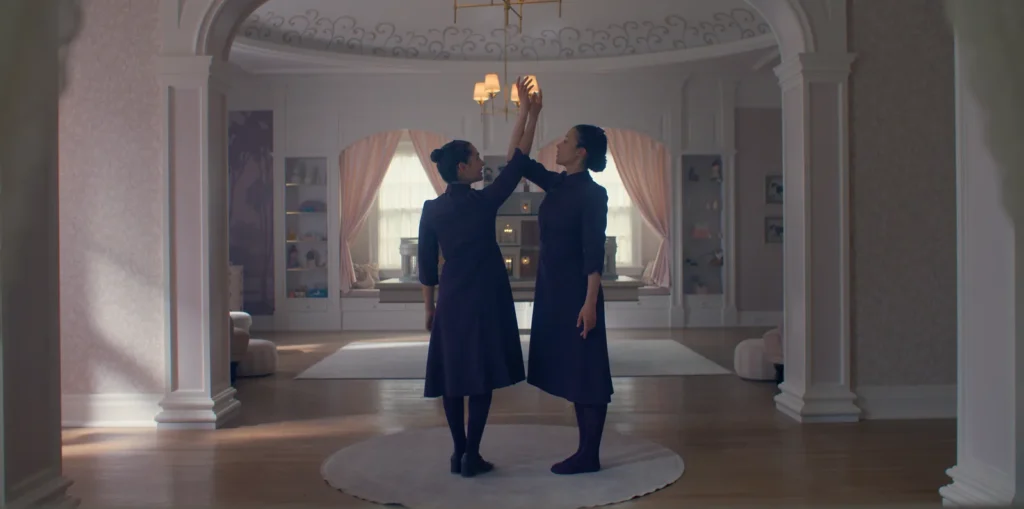
The viewer is initially presented with her point of view; it is that of someone on the inside, someone in the eye of the storm, a young woman raised in a sheltered, pampered, and privileged environment (the obvious analogy with her dollhouse) but also constantly exposed to an upbringing that has instilled in her, from childhood, blind obedience to God and to men. The encounter with her subversive sister—a stranger to her and an outsider to the system—upends this perspective, revealing the immense gap between reality and the lies she has been fed. The encounter occurs at a crucial moment for Agnes: when she reaches sexual maturity, forcing her to put those teachings into practice and become a devoted, submissive wife. Setting aside the narrative choices that diverge between the source material and the adaptation, The Testaments doesn’t add much new to the universe created by Atwood (the author makes a brief appearance in the final episode); what changes is the timing. In every sense.
Both because the Gilead of the series is no longer in its golden age—set in a period when it has already been undermined by rebel actions—and because the protagonists’ ages coincide with a time before the abuses began (Agnes is only now approaching puberty, while June had already endured the abuses reserved for handmaids), and because The Handmaid’s Tale and The Testaments —the first book was written in the mid-1980s, the second in 2019—were published when the future they depicted still seemed far off. The same applies to the first television adaptation of The Handmaid’s Tale, which dates back to 2017. The spin-off of The Testaments, however, is coming out now, at a time when women who have secured their own emancipation through control over their own bodies—by not marrying, by not having children—are seeing that right taken away from them, particularly in the United States, the future Gilead.
This overlap with reality changes everything, making the show even more terrifying. It is even more so in the way it explores the critique of patriarchy and its connection to pedophilia. In The Testaments, this is a pillar of the regime that gradually becomes the focal point of the first season’s narrative: in the early episodes, we witness the scene where Agnes’s father parades the young girl, who has just started menstruating, before a room full of potential husbands—leering old men licking their lips as they scrutinize their potential child bride, deemed ready for marriage just after her first period.
In the second part, a central storyline revolves around the abuse inflicted on some girls by a figure who is supposed to care for and protect them. The analogy with the increasingly extreme social phenomenon of the infantilization of women is chilling: according to the model being imposed on us, women must appear much younger, display a prepubescent physique, and be cute, coquettish, and submissive. The Testaments takes this process to the extreme, depicting a future that replicates the past (though in many parts of the world, it is the present), and in doing so, manages to be even more unsettling than The Handmaid’s Tale.
About the Author