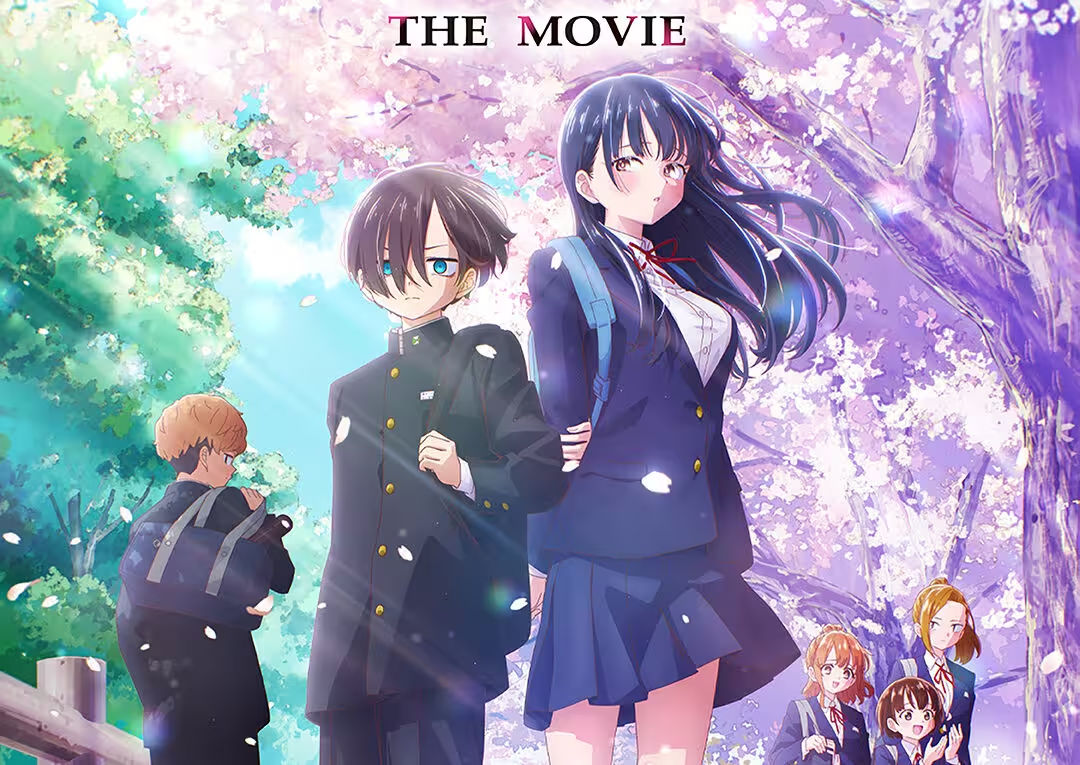
©Norio Sakurai(AKITASHOTEN)/The Dangers in My Heart Committee
The romance genre is one of the most popular in Japanese animation. This is because teenage love is always experienced in the most extreme way, and the Japanese have proven that they know how to express it best on more than one occasion. The latest arrival is The Dangers in My Heart – The Movie, one of the most beloved titles in Japan in recent years, based on the manga of the same name by Norio Sakurai, which has already been made into a series and published in Italy by J-POP Manga.
Two lonely souls meet in The Dangers in My Heart – The Movie
Kyotaro Ichikawa is an introverted and deeply insecure student with a passion for true crime, who cannot fully understand his own feelings. He does not know how to relate to others, as he is overwhelmed by the flood of emotions and hormones coursing through his teenage soul. Anna Yamada, a popular and always cheerful classmate, breaks through his heart. She is an aspiring actress who feels much more “lonely” than he thinks, with a constant melancholy in her eyes. Their story begins with small gestures and shared moments, which grow more and more until they become, perhaps, something else: but is that really the case?
A film that depicts the colors of adolescence

We could nickname the film “50 shades of adolescence.” This is because it manages to express very well the mood swings, silences, misunderstandings, and embarrassment typical of the age of first loves; when you discover that someone really likes you and, above all, you let them get close to your heart, showing yourself to be vulnerable as never before. Ichikawa and Yamada have to deal with this confusing whirlwind of feelings and, above all, manage to convey them to the other person.
The story begins at the end and is told backwards from the male protagonist’s point of view as he tries to reconstruct the signs that should have made him realize that perhaps there was a strong feeling on both sides. Gradually, we also discover more about Anna’s seemingly perfect, dream life: her doubts, dreams, and insecurities. The audience is invited to ask themselves whether she reciprocates the boy’s feelings or whether it is all in his head. The direction focuses on the characters’ glances and details, helping to create an atmosphere between dream and reality that perfectly expresses adolescence. The pace is reflective but at the same time eventful, entertaining audiences who love romance.
An unexploited feature: Kyotaro’s characterization
The Dangers in My Heart – The Movie has two main weaknesses: it is the offspring of many titles that preceded it, taking inspiration here and there and exaggerating certain sequences. Secondly, the characterization of the characters: the focus is entirely on the two protagonists, leaving the secondary characters – who often become obstacles to their possible relationship – only hinted at.
In addition, there is an aspect of Ichikawa that is abandoned during the course of the film: he is passionate about serial killers and in some situations shows slightly sociopathic behavior. His passion (he often reads books on crime) is what intrigues Yamada, as she also spends a lot of time in the library, and that becomes one of their favorite places. It’s a shame that this passion is lost in the course of the narrative; probably in adapting the manga, they had to cut and condense various parts of the story.
The main theme of the feature film: emotional self-sabotage.

Right from the title, the main theme of this anime film is a kind of mantra. Namely, that most of the time we are our own worst enemies. Ichikawa and Yamada are the first to sabotage themselves, remaining prisoners of their own thoughts and insecurities rather than learning to jump into the water and realize that it is not so cold after all. It will be the girl who will erase the darkness from the protagonist’s heart, showing him that a new feeling towards others is possible and that one must have the courage to make choices never made before.
Conclusions
The Dangers in My Heart – The Movie is a sentimental coming-of-age novel in which the two protagonists discover themselves and each other, form their own identities, and try to show themselves as they are without filters, amid embarrassment, growth, and mutual support. The romance part works, even if it is exaggerated to express adolescence, reminding us how good we are at sabotaging ourselves in love. The characterization works, even if it focuses little or nothing on the secondary characters, and some aspects of the protagonists are forgotten along the way.
About the Author