


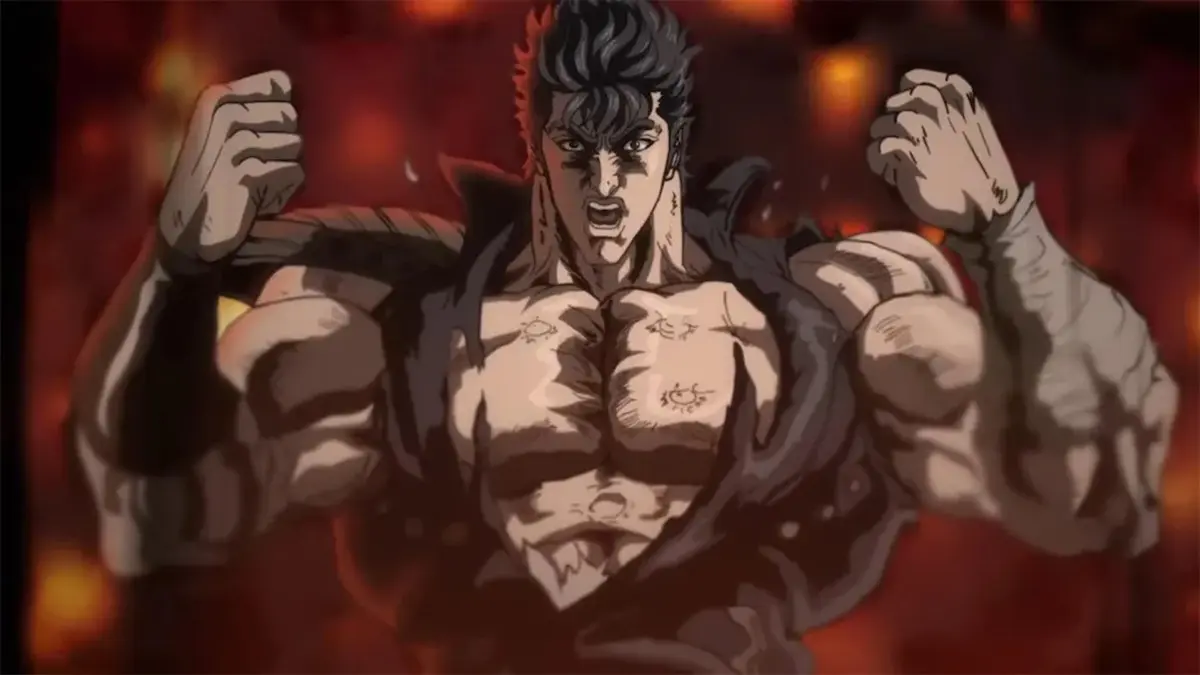
It always takes a good deal of courage to “remake” a cult classic, and the creators of this remake of a landmark series like Fist of the North Star (or Hokuto no Ken) certainly didn’t lack it. The series is now available on Prime Video with two episodes a week. The results fall well short of the good intentions, both from an objective critical perspective regarding the title itself and from a more subjective, nostalgic one in relation to the manga and the previous, historic adaptation.
A legend of the 1980s who influenced an entire generation, Ken was the heir to the Divine School of Hokuto, a young man with a funnel-shaped physique who roamed a post-apocalyptic world destroyed by nuclear wars. His favorite pastime was executing the marauders who attacked the defenseless. Endowed with the personality of a carrot, he had his girlfriend Giulia—queen of the coquettes—kidnapped by his rival Shin of the Nanto School, who had left him seven scars on his chest in the shape of the Big Dipper constellation as a memento. The experience had made him more combative, mature, thirsty for justice, and more interesting. Irony aside, the reason for the success of the manga by Buron Son and Tetsuo Hara (the latter a guest at last year’s Lucca Comics & Games) lay in the outcomes of Ken’s adventures, during which he encountered a host of memorable allies and magnificent villains—true icons such as his friend Rei, his brother Raul, the mad and desperate enemies Shin and Sauzer, and so on.
Struggling with the weight of that legacy, TMS’s adaptation aims for fidelity to the source material through a complete visual alignment with the original panels and a meticulous adaptation of the plot. Those who have read and reread the manga and watched the original anime dozens of times will initially appreciate the absolute fidelity of many scenes; by the time they reach the fourth episode, however, they realize that the creators haven’t truly captured the essence of the masterpiece, particularly its poignant sentimentality. Part of the blame lies with the animation, which suffers from clunky CGI. The dated 1980s adaptation featured a Ken with a sketchy six-pack, but all the characters were far more expressive than in this technologically advanced version. Looking at the character design, it’s clear that the reference models are those of Ken’s more recent depictions, which are overloaded with details—excessively so for an animated adaptation.
The CGI is also terrible in every other aspect: it’s unwatchable even in the fight scenes, which, for reasons we’ll explain, drag on far too long. A substantial difference from its predecessors is, in fact, the depiction of violence. Fist of the North Star is an extremely violent, brutal title, and the Prime Video adaptation emphasizes this characteristic by rejecting censorship: there are no flashes of light in place of spurting blood and exploding organs, no bodies silhouetted against the light. Instead, the staging takes great pleasure in dwelling on the most gory—and frankly far from elegant, as Shin rightly points out—aspects of the Hokuto discipline. We’re not saying we mind this, not as long as prolonging and lingering on those scenes without reason doesn’t overwhelm the narrative. Given that we’ve seen the original anime, some concerns also arise from the dialogue: Ken’s characteristic formal, courtly speech is often replaced by unjustified vulgar slang. This oversight seems to have been corrected in the most recent episodes; if so, resolving such a jarring element is a step forward.
We’re not sure this new version will resonate with younger generations, who lack the nostalgic fondness of Generation X and Millennials. Only the latter will be familiar with another key element of Fist of the North Star’s appeal: its unrestrained references—the protagonist’s Bruce Lee-esque moves, the look that gradually shifts toward Rambo, and the Mad Max-style settings with biker and punk marauders. A tear rolled down my cheek during the end credits, which played over the cover of “Tough Boy.” If only the inimitable original score had been included as well… Overall, there’s no risk that this new version will become a cult classic capable of shaping the minds, ideals, and imagination of its audience like the manga and the 1980s adaptations did. Would it perhaps have made more sense to focus on the part of the comics whose adaptation remained unfinished at the time? Perhaps so.


